Even those people who sparsely follow the news or read paper and say have done so only once in last 30 days would not have missed the 'Clemenceau' story. It has been covered extensively in national and international media. Blogosphere has been quite active in this regard.
It is very easy to get swayed by 'fragile earth' sentiment which
Greenpeace has been vociferously advocating, there are many more facts and facets to this issue.
Greenpeace has been protesting right from the
start. First, Greenpeace activists did not let Clemenceau leave France and next at the Suez they chained themselves to the mast and came down only when
Egypt said that it would ask for the documents which show compliance under Basel Agreement. Supreme court monitoring committee (SCMC) has submitted its report to the Supreme court and a
decision would be pronounced on 13th Feb on the fate of the ship entering India's territorial waters. Meanwhile Greenpeace decided to take its protest one level further. It has announced intent to
dump garbage outside the French Embassy in New Delhi to show that India is not a place to dump garbage. Almost 3500 people across the country have joined this protest and a few
celebrities too have thrown in their hats.(
here)
Amidst all this what has been the central issue is the condition of Alang (
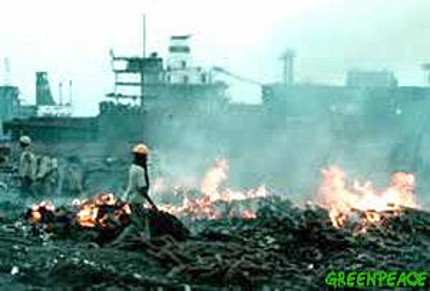
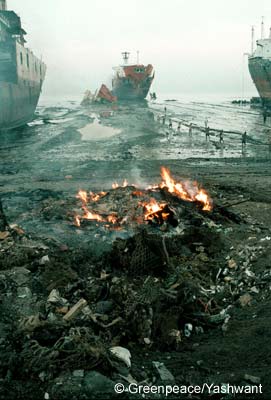
A travellers blog on Alang) ship breaking yard, the world's largest ship breaking yard. Greenpeace claims that the safety conditions are ridiculously below par to allow decommissioning of Clemenceau there.


These pics here may be at the extreme end of the spectrum taken by Greenpeace but the fact remains that it is unsafe for the workers to decommission the ship at this yard.
But, is anyone listening to these workers? Isn't it their livelihood? Aren't they aware of the health hazards they are facing? Aren't they making a conscious choice to accept it? Does India have a legislation which stipulates safety norms for hazardous jobs? I am not aware of it. But do we need a legislation for this? Does everything need a legislation?
It is obvious that the workers of Alang and the affluent contractors will protest. They are slowly but surely moving in this direction. From organising protests in Alang and one day bandh, they are moving in to garner political support for against Greenpeace intervention in Alang. They claim that
Greenpeace is intervening in the prosperty of Alang.
They are not just
protesting against Greenpeace. But they are protesting and fighting for their livelihood. For their survival. Most of the workers are daily wage workers and work in poor conditions but thats the only thing they know to do. They claim that this action by Greenpeace would hinder other ships also from coming to Alang and hence destroy the Ship-breaking industy in India. India,Pakistan, China, Bangladesh and Turkey account for more than 90% of world's ship breaking and Alang workers and contractors claim that they are steadily losing market to these other countries.
Greenpeace is visibly shocked over the protests.
Greenpeace sees this as an opportunity to raise consciousness across the world on dumping activities of developed nations. The Clemenceau issue has definitely raised global consciousness, may be by a miniscule amount but it sure has. In India definitely people are more aware.
Now what about those workers in Alang? If the ship breaking industry in India dies because of this, should it be accepted as a result of triumph of Greater Common Good over few thousand workers' livelihood? Who is to take this call?
There are many more similar questions that can be raised. These questions are as real as the lives of these people that they are about. They may have answers. May be they dont. But these questions have to be answered and issues addressed.